

Selling property in the Canton of Zug
Selling in the Canton of Zug: your return decides the tax.
Zug calculates property gains tax from the gain per year of ownership – not from a fixed table. Working this out before you sell shows what you really keep.

As of September 2026 · Tax law of the Canton of Zug (BGS 632.1), version of 1 January 2026.
What most people overlook: in the Canton of Zug, the builder’s old invoice for the extension does not just lower the gain. It can also lower your rate.
Property gains tax · Zug
How much property gains tax do you pay in the Canton of Zug after many years?
After 25 years of ownership, property gains tax in the Canton of Zug is at most 25 % of the gain. That is a ceiling, not a fixed rate. A lower return per year becomes your rate, but never below 10 %. Return is the gain divided by the investment costs (Anlagekosten): purchase price plus value-adding work.
For the same gain, every extra year lowers your return per year, and part-years count in full. From year 12, the ceiling falls every year too (§ 199 Zug Tax Act, as of 1 January 2026). Example: a CHF 450,000 gain on CHF 200,000 investment costs after 15 years. That is a 15 % return per year, so a 15 % rate and CHF 67,500 in tax.
What this means for you: keep the old purchase contract and the invoices for extensions or alterations. Each documented franc lowers the gain and raises the investment costs. Both push your return down, so your rate can fall too. Maintenance such as repainting does not count.
Your tax rate also depends on a figure you will not find in any folder: the realistic sale price. The valuation provides it, with a net calculation: what remains after tax, mortgage and costs. In writing, as a basis for talking with your children or parents.
Selling in the Canton of Zug
Selling a house in the Canton of Zug: which tax rules should you check before you sign?
When you sell a house in the Canton of Zug, two property gains tax rules matter: the deposit and the deferral limit. At the signing of the purchase contract (Beurkundung), a deposit or security is due. It covers the expected tax. The buyer is also liable for it (§ 202 Zug Tax Act, as of 1 January 2026).
Selling the home you live in and buying another in Switzerland can defer the tax (Ersatzbeschaffung). The window is normally two years either side of the sale. To defer it all, the new home must cost no less than the proceeds. Otherwise, part or all of the gain is taxed at the rate for the whole gain (§ 191).
What this means for you: budget for the deposit before you buy again. For the deferral, price counts, not size. If the new home costs less than your proceeds, waiting or keeping the house may work out better. The six-question home check helps you weigh it up; Immosmile’s sale process helps you plan.
What is different here
What you should know about selling in the Canton of Zug.
Return instead of a table
The rate equals your gain relative to the investment costs, converted to one year – at least 10 and at most 60 %. From twelve years of ownership the maximum rate falls by 2.5 percentage points a year and is 25 % after 25 years – if your annual return is lower, that lower rate applies, but at least 10 %. Gains below CHF 5,000 are tax-free.
Tax deferred
If you sell the home you live in and, as a rule, buy or build a new one in Switzerland within two years, the tax is deferred – to the extent the proceeds are reinvested (§ 191 tax law ZG).
With the municipal clerk
The purchase contract is usually notarised by the clerk of the municipality where the property is located. In Zug, lawyers may not notarise an ordinary house sale (section 7, notarisation act). Buyer and seller each pay half of the land registry fee unless agreed otherwise.
Municipalities
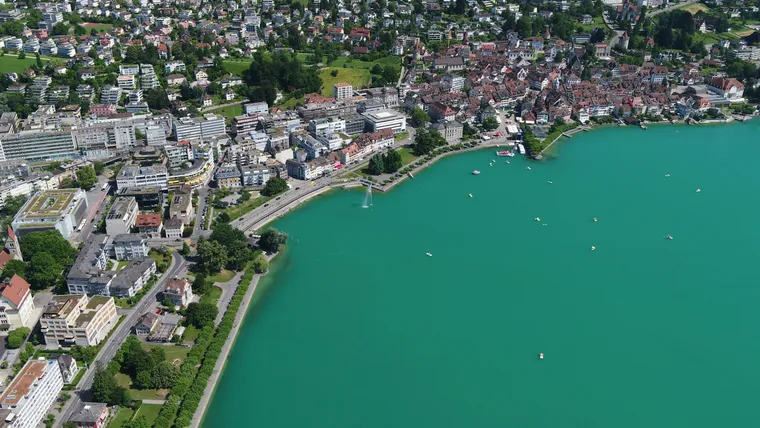
Eleven municipalities – from the lakeshore to the Ägeri valley.
The Canton of Zug has no districts; people distinguish between the valley and the hill region. We are happy to talk about your property in person.


Getting there
From the office at Bahnhofplatz Zurich
By train from Zurich HB, fastest connection on a weekday (SBB timetable).
- Zurich HB → Zug 24 min · direct
- Zurich HB → Baar 23 min · direct
- Zurich HB → Rotkreuz 36 min · direct
- Zurich HB → Unterägeri 48 min · 1 change
Questions from the Canton of Zug
What owners here want to know.
How high is property gains tax in the Canton of Zug?
There is no fixed percentage. The rate equals the annualised ratio of gain to investment costs and lies between 10 and 60 %. From twelve years of ownership the maximum rate falls by 2.5 percentage points a year; after 25 or more years it is 25 % (§ 199 tax law ZG). The assessment is made by the municipality where the property is located.
Do I pay tax on a small gain?
No. Property gains below CHF 5,000 are not taxed in the Canton of Zug (§ 199 para. 4 tax law ZG).
Can I defer the tax if I buy a new home?
Yes. If you sell property you permanently and exclusively live in and, as a rule, use the proceeds within two years before or after the sale for a replacement home in Switzerland, the tax is deferred. Gains that are not reinvested are taxed (§ 191 tax law ZG).
Is there a property transfer tax in the Canton of Zug?
No. There is a land registry fee based on effort, owed half each by buyer and seller unless agreed otherwise (land registry fee schedule, BGS 215.35).
Who notarises the purchase contract?
The clerk of the municipality where the property is located – in exceptional cases, with written authorisation, the land registrar. Lawyers may not notarise an ordinary property purchase in Zug (sections 4, 6 and 7, notarisation act, BGS 223.1).
Inherited your parents’ home in the Canton of Zug: which purchase price counts for property gains tax?
As a rule, your parents’ purchase price counts, and so does every year since (§ 193 Zug Tax Act). An inheritance only defers the tax, as do gifts and advances on inheritance during their lifetime (Erbvorbezug, § 190). More than 25 years after their purchase, you may instead use the house’s value 25 years ago, with exactly 25 years of ownership (§ 195). Only a calculation using the purchase contract shows which option is cheaper.
As an estate agent from Zurich, do you also sell houses and flats in the Canton of Zug?
Yes, from the office of Immosmile GmbH at Bahnhofplatz 1 in Zurich, but Zug law governs tax and the signing of the contract. So we apply the Zug Tax Act, not Zurich rates. From the first conversation to the final signature, your contact is Dominik Devaja, managing director. The valuation is free and without obligation, even if our recommendation in the end is «keep it».
Sources
- Tax law of the Canton of Zug (BGS 632.1)
- Property gains tax leaflet, calculation of the rate (Municipality of Risch, Canton of Zug)
- Land registry fee schedule, Canton of Zug (BGS 215.35)
- Notarisation act, Canton of Zug (BGS 223.1)
- Municipalities of the Canton of Zug
General information, not tax advice. You receive the exact calculation for your property in the free valuation.
Your contact for the Canton of Zug
Want to know what you keep in Zug after tax? Call me.
From Bahnhofplatz Zurich I am in Zug in 24 minutes. You get an honest assessment – even if it says «wait».
